
Reading Design Anew as a Critical Practice
august 17, 2026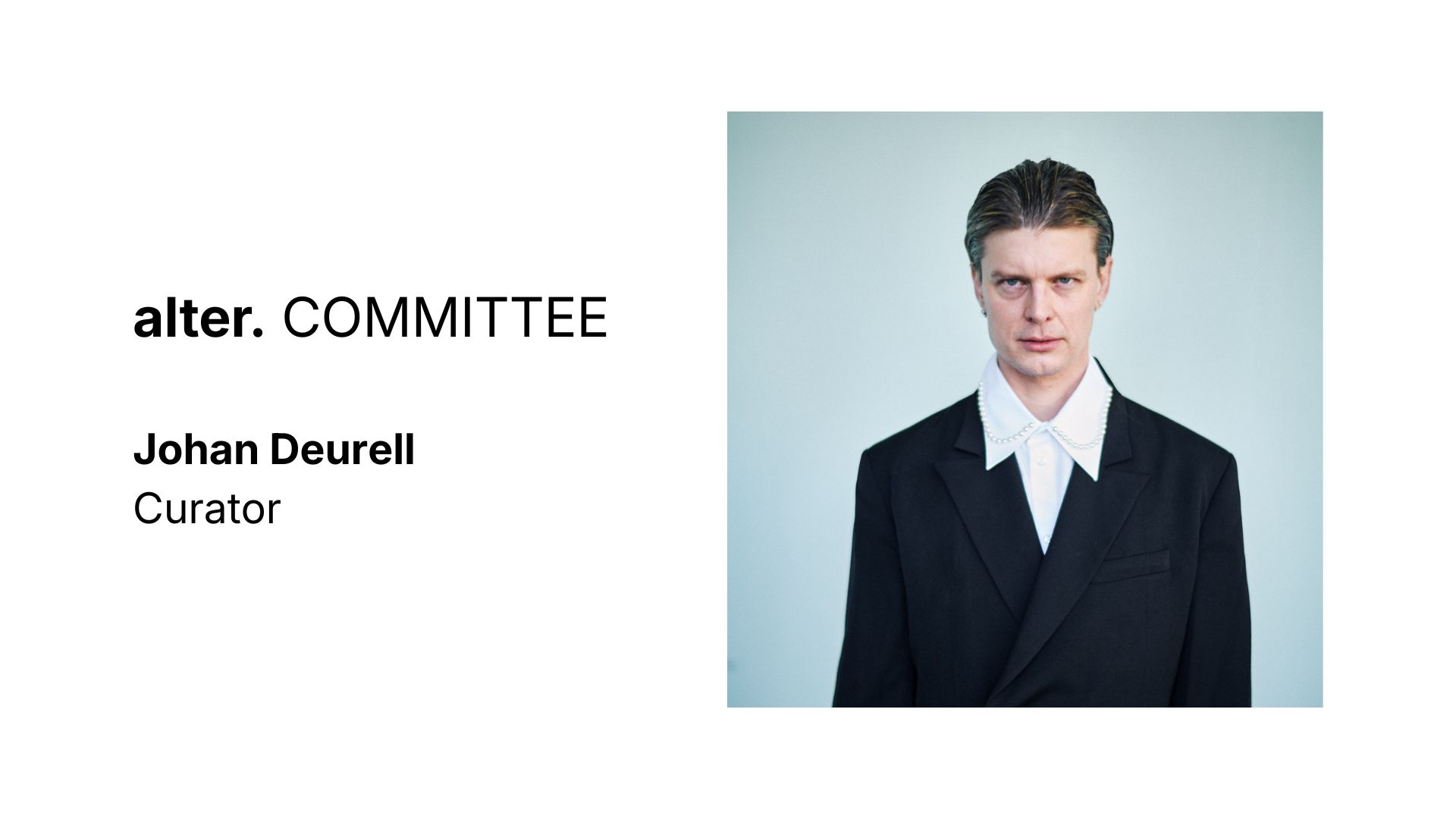
The projects shown at alter. are selected through deliberation by committee members from Japan and abroad. Drawn from a range of fields — curators, journalists, architects and others — each member approaches product design from their own distinct vantage point. Through alter.’s Journal, our interviews set out to reveal how each committee member sees contemporary product design.
Our fourth interview is with Johan Deurell, curator at the Vitra Design Museum. At the Röhsska Museum of Design and Craft in Sweden, he curated “Unmaking Democratic Design,” an exhibition that questioned the myth of “democratic design,” and he is currently at work on a retrospective of the Sri Lankan architect Geoffrey Bawa. Approaching design as a “critical practice” tied to social and political discourse, how does Johan view contemporary product design and the role of museums?
Design Is Connected to Society and Politics
──Could you walk us through the career that has brought you to where you are today as a curator?
I’d say my career trajectory has been shaped by circumstances, chance, and determination. I’ve always been obsessed with visual and material culture. My undergrad was in history of art and curatorial studies, and after working in art galleries, I studied a postgrad degree in the history of design.
──How do those studies connect to the curatorial work you do now?
This has shaped how I think about material culture and the built environment. I am interested in wider cultural, social, and political discourses, and how these are manifested in art, architecture, and design. Historically and today.
──Before becoming a curator, your work as a journalist and a lecturer was significant. How have those experiences shaped what you do now?
I guess these two experiences push me to ask myself what makes something relevant now, as well as being mindful of what makes something an engaging learning experience.
View this post on Instagram
How, of What, and for Whom
──What kinds of themes have you explored as a curator so far?
In my curating, I have explored themes like migration and cultural hybridity, queerness, humanitarian rights, the environment, and climate change. Subject matters that concerns everyone, and resonates with my personal interests, too.
──And what themes are drawing your interest right now?
Right now, my curatorial focus is very much on the built environment, and ideas about living with nature, rather than against it; I am currently working on a retrospective exhibition on the Sri Lankan architect Geoffrey Bawa (1919–2003) who pioneered ecological approaches to architecture. The exhibition is co-curated with Ikko Yokoyama, M+, Hong Kong, and Shayari de Silva, the Geoffrey Bawa Trust, Colombo, and opens at the Vitra Design Museum, Weil am Rhein, in September.
──What perspectives do you bring to your work as a curator?
As I said, I’m interested in societal discourses and how these pertain to art, architecture, and design. Or is it the other way around?
──When it comes specifically to contemporary product design, what do you look for?
With contemporary design, I am looking for objects that say something about our time — how are they made, what are they made of, and who are they for. At the same time, I also think any curator would admit that the first emotive response to an object is also important — if it doesn’t evoke anything, then it’s sort of a dead object. And of course, all of this is highly subjective.
View this post on Instagram
Questioning the “Myth” of Design
──Your exhibition “Unmaking Democratic Design” feels like a quintessential example of “critical curation.” How did the project come about?
I was new at the Röhsska Museum of Design and Craft, Gothenburg, and the museum was in a process of rethinking its role and mission. Historically, the museum had told a canonical history of design, in which Scandinavian Design — itself a construct — was imbued with certain values. One of these values was the idea of democratic design.
──Which aspects of “democratic design” did you want to question?
What makes Swedish design so democratic? In the west, democratic design has become shorthand for something cheap and consumer-friendly, in the idiom of Ikea and H&M. I was keen on challenging this myth of democratic design, and shifting focus away from consumers towards materials, the making, participation, and power.
──The exhibition focused on the Swedish designer Fredrik Paulsen and on the typology of the chair.
I commissioned him to work on this theme with me, and we decided to work on it through the chair typology. It became a very successful exhibition. Museum visitors were almost mass-producing Autoprogettazione-inspired chairs, while at the same time making something with their own hands.
View this post on Instagram
Design as a Critical Practice
──Such curatorial work has social and political perspectives woven into it. When you approach product design not solely through “beauty” or “function” but through its relationship to society, which perspectives do you weigh most?
I’m interested in design as a critical practice. Materials, skills, and techniques are part of much bigger networks, so looking at the processes behind a design tends to open up other enquiries.
For example, when I curated Ocean Plastics, we exhibited critical design projects such Formafantasma’s Botanica and Studio Swine’s Ocean Gyre. The former was investigating pre-industrial era bioplastics, such as resin and horn. The latter was about collecting and processing plastic waste found at sea.
──What comes into view through projects like these?
Both say something about contemporary society’s dependency on synthetic materials, but more importantly, about design as an agent for change.
──When design is taken as a critical practice and an agent for change, what challenges do you think contemporary product designers face?
As the ongoing humanitarian crises and the climate emergency bring to light, the dominant global economic model relying upon extractive policies needs rethinking. It would be naïve to think these economic and geopolitical challenges can be solved by designers alone; however, designers are trained in holistic thinking and solving problems through what is sometimes called design thinking.
──What role do you anticipate for designers going forward?
I anticipate a future where designers will increasingly become interdisciplinary researchers, operating across cultural and institutional borders, and using their skillsets to come up with clever and practical solutions for the challenges we are facing.
View this post on Instagram
Stories Only Prototypes Can Tell
──alter. places strong emphasis on the process of exhibiting prototypes. When dealing with unfinished works or pre-commercial products in a museum or curatorial context, what possibilities and challenges do you see?
For me, prototypes, maquettes, toiles, sketches, and so forth are all exciting material in a curatorial context, as they help us convey how an object came to be.
Of course, different exhibitions have different goals, but if the curatorial narrative is about design processes for industrial design or serial production, telling this story without prototypes feels a bit futile.
──The Vitra Design Museum holds many archives that tell exactly that kind of process story.
The Vitra Design Museum is the custodian for the estates of prominent designers such as Alexander Girard and Verner Panton and holds significant parts of Charles and Ray Eames’s archive. What these collections can do is to tell interesting stories about how an industrially produced piece of furniture is the result of experimentation, trial, and error. This is both engaging and inspiring for audiences.
View this post on Instagram
What Nordic and Japanese Design Share
──alter. evaluates products through three perspectives — “function,” “beauty,” and “expression.” Which will you weigh most heavily in this round of judging?
All the criteria you mentioned are important, and the different aspects relate to one another, too. “Function” can hold multiple meanings: What problem does the product solve? What is its function within a group of objects or society at large? Does it work? All of this is important to consider.
“Expression” includes visionary thinking and experimentation, and the designer’s point of view and intention, so I am equally interested in this. Beyond this, I am looking for informed approaches and expansive thinking, as well as visually and materially appealing products made in a considered way. Maybe the latter is “Beauty”?
──Nordic design is highly regarded internationally and functions as a kind of reference point. What impressions do you have of Japanese design?
Growing up in the 1990s, I first encountered Japanese design culture through video games, toys, manga, and anime, but also through tech products and automobile design. As I grew older, I got interested in Japanese fashion, and in particular the work of Rei Kawakubu and Issey Miyake.
──From your vantage point, what characteristics of Japanese design stand out?
On a personal note, playing video games was the first time I started making connections between a specific design culture and a country. Without sounding essentialist, and with the understanding that all design cultures are the result of cultural and transhistorical exchange, I think there are some commonalities between Scandinavian and Japanese design.
Whether rooted in Lutheranism, Shinto, or Zen Buddhism, these geographically distant design cultures have in their own ways searched for the true essence in objects, which meant paying attention to the details and materials, rather than larger gestures. With Japanese design, I particularly admire the precision and materiality. There are also these ideas about negative spaces and blurring of inside-outside that are often associated with Asian architecture.
──And how do you see contemporary Japanese creators?
Today, I think we are seeing a lot of reinterpretations of Japan’s design culture, marrying traditional crafts and material approaches to the technological and structural systems available now.
View this post on Instagram
Museums Are Becoming a Place for Debate
──When thinking about the future of design, what role can museums play?
Museums serve society by researching, collecting, preserving, interpreting, and exhibiting heritage. Today, museums are active spaces for sharing research and creating new knowledge together with audiences. As such, museums can have an activating role and be a space where design or architecture is debated, challenged, and interpreted together to envision a better future.
──So a museum is not simply a space that exhibits works neutrally.
Museums are increasingly reckoning with the fact that they are not neutral spaces, and that can also open doors for making progressive statements and being a space for different opinions. I think museums should be a space for equity and diversity. Some of my favourite museum projects are the ones in which audiences and designers are learning together.
──Finally, a message for the exhibitors at alter.
I’m excited about this platform for contemporary design culture in Tokyo, which gives designers the opportunity to gain exposure, get feedback, and make connections. After engaging with all the entries, my expectation for the exhibition is to see a lot of interesting work and learn more about these designers’ ideas.