
Creativity Is a Form of Enquiry, Not a Discipline
august 15, 2026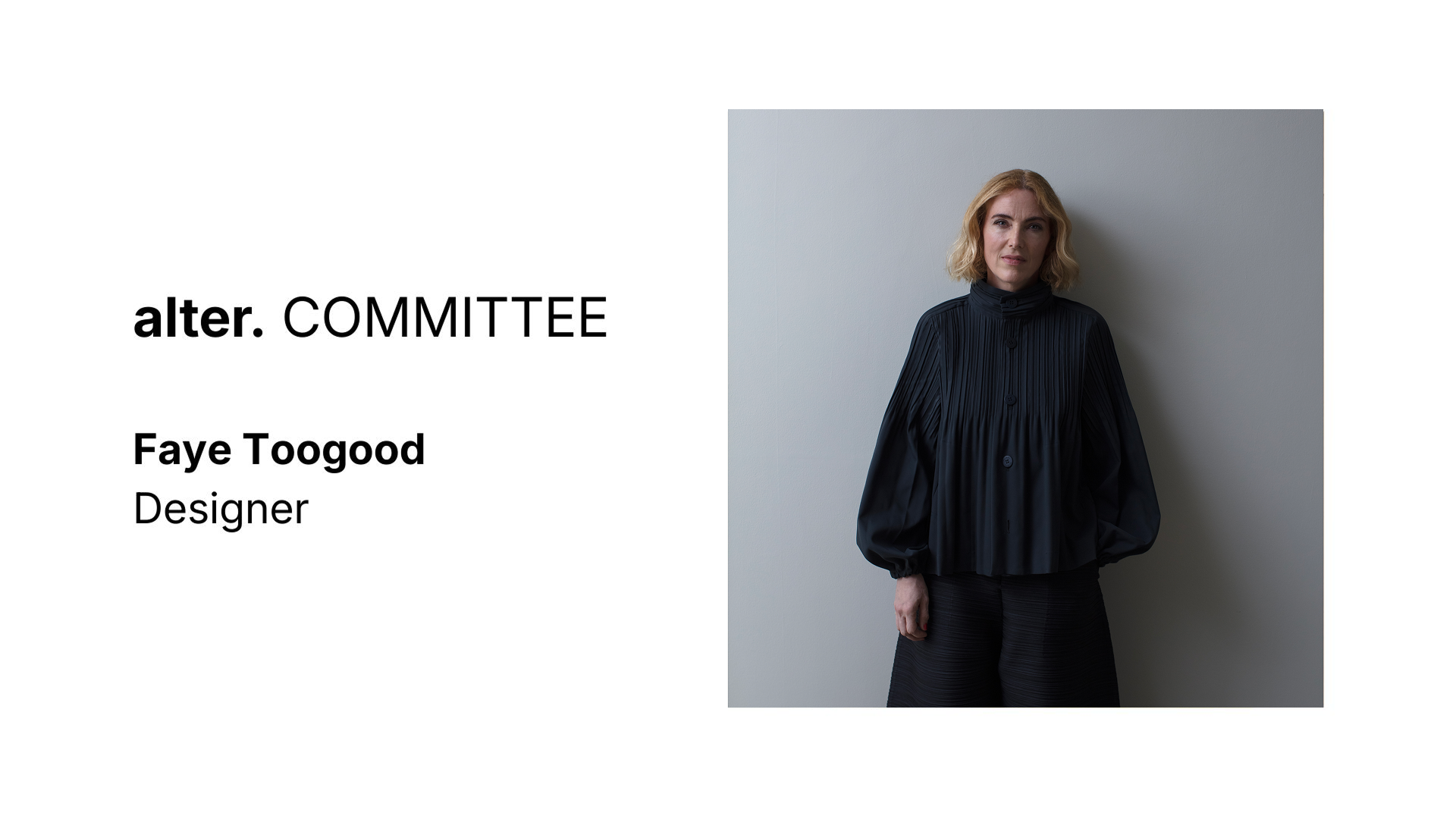
The projects shown at alter. are selected through deliberation by committee members from Japan and abroad. Drawn from a range of fields — curators, journalists, architects, and others — each member approaches product design from their own distinct vantage point. Through alter.’s Journal, our interviews set out to reveal how each committee member sees contemporary product design.
Our second interview is with Faye Toogood, a London-based designer whose practice moves across furniture, fashion, sculpture, and interiors. Her work — including the “Assemblage” series and the “MANUFRACTURE” project at the Stockholm Furniture Fair — unfolds as a “body of thought” that reaches beyond any single product. What, then, does she hope to see from designers of her own generation?
Design as Enquiry, Not Discipline
──Your practice moves across many fields — furniture, fashion, sculpture, interiors. How did your current work come to take shape?
My career has never followed a straight line. I trained in art history, worked as an editor, then moved across fashion, interiors, furniture, and sculpture.
──Was crossing between categories something you were conscious of from the start?
I have always resisted fixed categories because I see creativity as a form of enquiry rather than a discipline.
──Across these different creative categories, is there something that runs through your work consistently?
The foundation of my work comes from a fascination with emotional response — how objects shape behavior, how materials carry memory, and how form can influence feeling. Recently, I have become increasingly focused on imagination, play, gesture, and touch, especially at a time when so much of life feels digital and disconnected from physical experience.
View this post on Instagram
A Story Told Through Material and Form
──Does your background in art history connect to your design work?
Art history taught me how to look. Studying art history gave me an understanding that objects exist within wider cultural and emotional histories.
──What about your experience as a magazine editor?
Editing taught me how to shape a narrative. Editing trained me to think about composition, rhythm and clarity. Both experiences continue to shape how I approach design — not simply as function, but as storytelling through material and form.
──Do you carry that mindset across all the fields you work in?
What remains constant is my commitment to materiality, emotional response, and making by hand. I always begin physically, through touch and experimentation rather than purely digital processes.
──On the other hand, each field — furniture, fashion, and so on — seems to have its own rules.
That is precisely why I enjoy moving between them. Fashion, furniture, sculpture, and interiors all demand different ways of thinking about the body, space, and function.
View this post on Instagram
Prototyping Is Discovery; Production Is Where Compromise Begins
──Your “Assemblage” works are released as a numbered serial body. How does developing pieces as a series differ from making a single, standalone product?
The Assemblage series is less about designing individual products and more about building a body of thought. Each piece evolves from the previous one, allowing forms and ideas to develop over time.
──So you’re not trying to create one perfectly finished product.
I am less interested in creating one perfect object than in allowing a collection of works to form a larger emotional language together. Working as a series creates space for experimentation and contradiction.
──At “MANUFRACTURE” during the Stockholm Furniture Fair, you opened up the production process itself to the public. What significance do you find in showing not the “finished product” but the “process of making”?
For me, process is not separate from the work — process is the work. At MANUFRACTURE, I wanted to reveal the labour, experimentation, and uncertainty behind making. Contemporary design often shows only polished outcomes, but I think the gestures, mistakes, and adjustments are what give objects humanity and emotional depth.
──Thinking about the process of making a product, your mindset must shift as you move from prototyping into mass production.
Prototyping is where discovery happens; production is where compromise begins. I am interested in maintaining the emotional and tactile integrity of a work as it moves into larger-scale production.
──Then what does “scale” mean for a designer?
Scale can democratise design, but it can also flatten character and intimacy. I think designers need to ask carefully what is gained — and lost — when something scales.
View this post on Instagram
Holding Discipline and Experimentation Together
──alter. evaluates products through three perspectives: “function,” “beauty,” and “expression.” Which will you weigh most heavily in this round of judging?
Expression is probably the quality I value most because it is the hardest to achieve.
──Why is “expression” harder than “function” or “beauty”?
Many objects function well and look refined, but fewer possess a distinct emotional point of view. I am drawn to projects that feel honest, sensitive, and courageous — where material, concept, and form feel deeply connected rather than simply styled.
──In pursuing that kind of expression, what challenges do you think contemporary product design and designers face?
I think contemporary design is struggling with speed and overproduction. There is enormous pressure to constantly create new images and products, often at the expense of depth and material understanding. I also think design criticism has weakened. Without critical discourse, it becomes harder for the field to evolve intellectually or question its own systems and values.
──What impressions do you have of Japanese creativity and design?
Japan has had a profound influence on me. I deeply admire the sensitivity toward material, ritual, and atmosphere that exists within Japanese creativity. What excites me most about contemporary Japanese creators is their ability to balance discipline and craft with experimentation and hybridity. There is often a seriousness toward making that I find incredibly inspiring.
──What do you hope to see from alter.’s exhibitors?
The most memorable work is rarely the most polished — it is the work that reveals conviction, curiosity, and a genuine relationship between maker and material. I hope people feel able to show experimentation, vulnerability, and process, not only finished perfection.