
Looking at Local Practice and the Context Behind It
august 15, 2026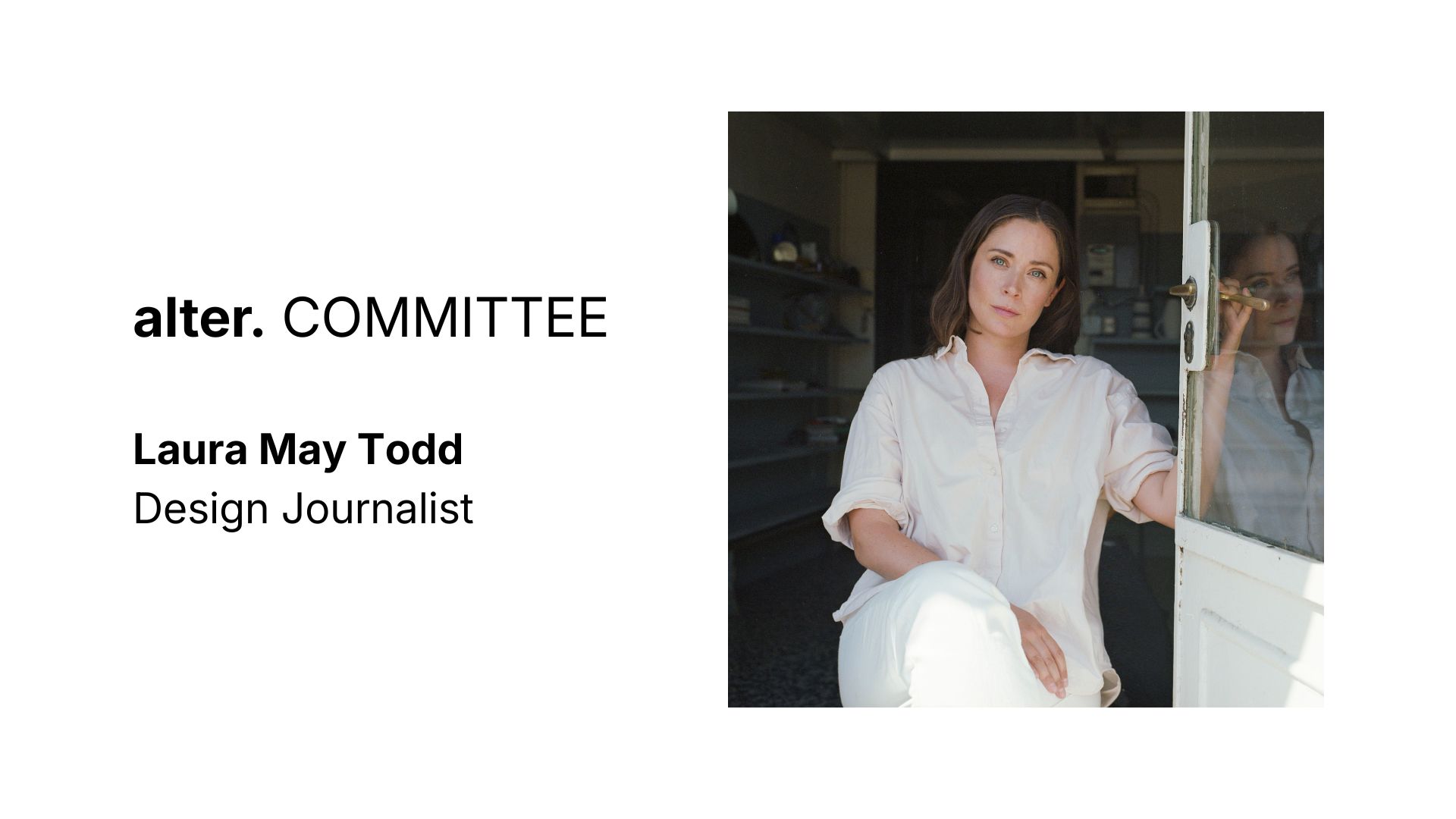
The projects shown at alter. are selected through deliberation by committee members from Japan and abroad. Drawn from a range of fields — curators, journalists, architects and others — each member approaches product design from their own distinct vantage point. Through alter.’s Journal, our interviews set out to reveal how each committee member sees contemporary product design.
Our first committee member is Laura May Todd, a design journalist whose work appears in global design media, including Wallpaper*. Starting her career in book editing and now reporting on local design cultures around the world, how does she see the role of journalism and media as they stand between the global and the local?
The Richness That Lies Behind a Design
──Today, you write as a design journalist for various publications, including Wallpaper*. Could you walk us through the career that has brought you here?
I began my career in book publishing at Phaidon Press in the UK before moving into journalism. Today, I’m based in Milan and write about design, architecture, and interiors for several international publications.
──Is there something you always keep in mind as a journalist?
My journey as a journalist was beginning at the same time I was adjusting to living in an entirely new country, meaning that I was discovering Italy’s broader culture and learning its language while, at the same time, I was covering its design industry.
I realized that as an outsider, it’s truly impossible to understand a design culture without also understanding its history, language, and social context. So now, when I approach other cultures, I do so with that in mind.
──As you moved from book editing to magazine and online journalism, how has your own perspective shifted?
As with the case in any profession that includes a great deal of research, the more you learn, the more you realize you don’t know — and how much more there is to discover.
View this post on Instagram
The Fragility of Cultural Ecosystems
──You’ve reported on local design cultures across the world — India, China, Lebanon, Ukraine. Is there an assignment that has stayed with you?
One of my most memorable assignments was a trip to Ukraine to discover the region’s traditional craft culture in 2019. Myself and a group of other journalists and designers and I were taken to rural villages around the country to visit carpet weavers, ceramicists, and wood carvers, who all specialized in traditional techniques. It was an incredible introduction to the rich cultural heritage of the country.
──A few years later, war broke out in Ukraine.
Not only were these craft traditions and their practitioners at risk, but we were among the last few international observers to experience them in relative peace. It really taught me how truly fragile these cultural ecosystems can be.
──Local craft and culture are themselves shaped by global forces, aren’t they? Is it possible for them to connect with the outside world while keeping their integrity, rather than being consumed by the global market?
Certainly, craft is a very powerful way of understanding a culture. The various societal forces that lead to the development of a craft tradition are so important to keep in mind when covering design as a foreign journalist. It’s not enough to simply document the object or the maker, but rather to understand the wider context from which they emerge. These often become the most interesting parts of a story.
View this post on Instagram
An Expanding Product Design
──In an era when anyone can publish on social media, what role do you see global media like Wallpaper* taking on?
In an age of endless online content, publications still play an important role by providing context, critical perspective, and editorial rigor. Social media is valuable for discovery, but journalism can connect design to larger cultural conversations and offer a deeper understanding of why certain work matters.
──The role of editing must matter more, too.
There is a lot to be said about the importance of editing, as well. More often than not, ideas should be put under scrutiny by editors who have experience and skill.
──Through your editing and writing across various publications, how do you feel the positioning of product design, the discourse around it, and its influence have shifted?
I think the definition of what we consider product design has greatly expanded. You only need to look at events like Salone del Mobile — which, being in Milan, forms a major part of what I cover each year — to see that the fair has evolved from a straightforward furniture expo into a much broader cultural event, with participation from the fashion, beauty and technology worlds. It’s a good example of how product design is increasingly being adopted by other creative industries.
View this post on Instagram
Paying Attention to Smaller, Local Practice
──alter. evaluates products through three perspectives: “function,” “beauty,” and “expression.” Which will you weigh most heavily in this round of judging?
I hope to have a fair mix of all three! When judging a design project, I think it’s important that it’s as multifaceted as possible. Something that is functional but not beautiful will definitely fall short. While something that is driven purely by expression or beauty can risk being considered an art object, rather than a functional piece of design.
──So product designers need to approach their work from multiple angles. What challenges do you feel contemporary product design and designers are facing today?
The main complaint I hear from young designers today is the rising cost of exhibiting. It’s a huge financial investment to show at a major international fair like Milan or Copenhagen, but many simply don’t have the means to do so.
──On the other hand, the number of platforms — design events like alter. included — has been increasing too, hasn’t it?
So on the one hand, there are now more platforms and opportunities for designers than ever before, but access to visibility can still feel incredibly unequal. I also think it’s the responsibility of industry professionals and journalists to pay attention to what is happening at smaller, regional fairs and exhibitions, in order to support a broader and more diverse design ecosystem.
──As someone who has covered local design around the world, what impressions do you have of Japanese creativity and design?
What I admire most about Japanese design is its sensitivity to material and detail. Contemporary Japanese designers are particularly interesting because they combine deep respect for tradition with highly experimental approaches.
──Discussions of Japanese design often center on historical practice, but it sounds like contemporary designers are what really draw your eye.
I’m also drawn to the sense of restraint and thoughtfulness that often characterizes Japanese creativity, especially in a global culture that increasingly prioritizes speed and constant visibility.
──alter.’s exhibitors may be exactly those kinds of creators. What are you looking forward to at alter.?
I’m mostly looking forward to getting to know new, young, and up-and-coming designers. Whether or not they eventually make it to the final stage, judging a platform like alter. is a great way of discovering what is happening in the contemporary design scene, both in Tokyo and beyond.