
Design Events Help Us “Break the Algorithm”
september 18, 2026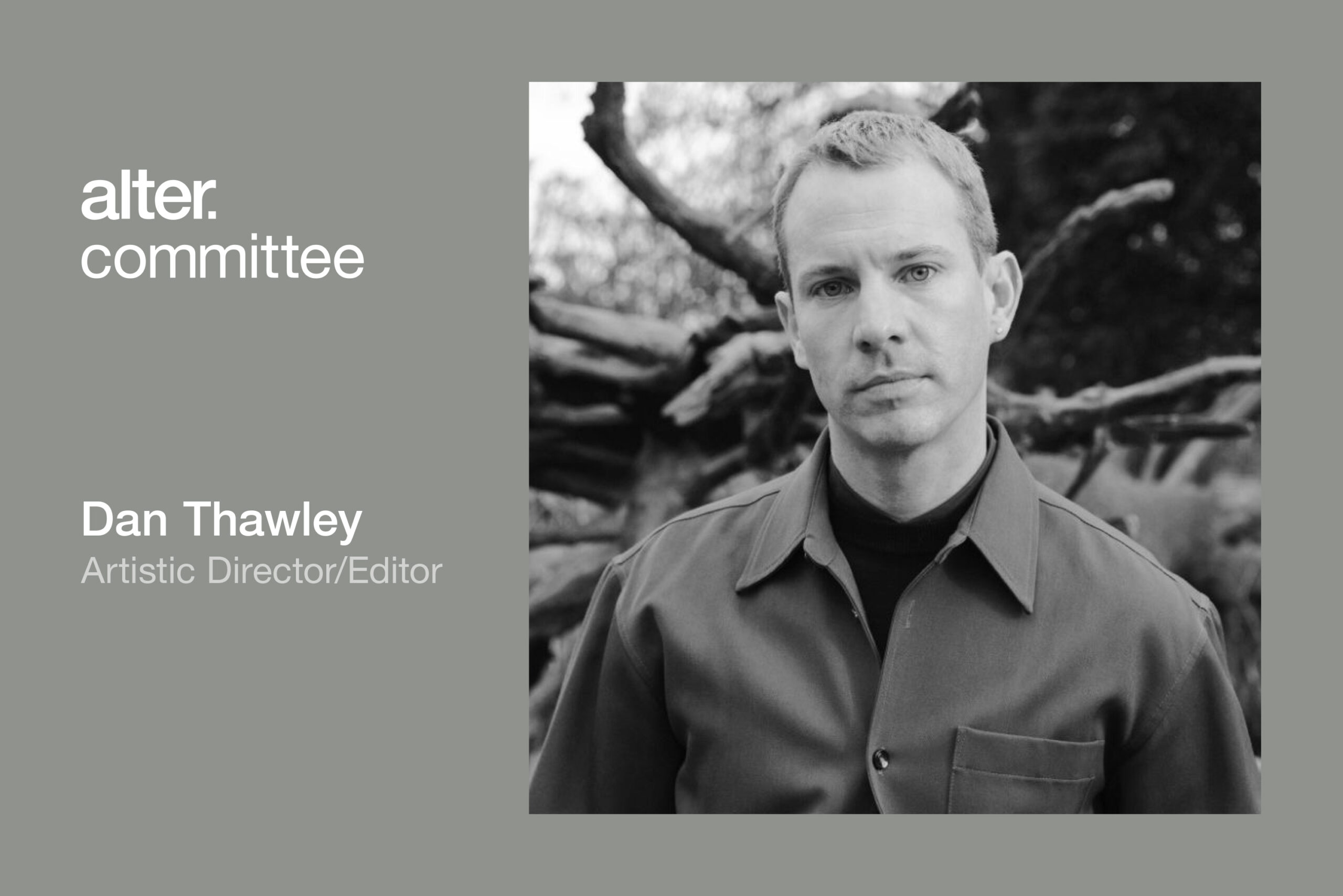
The projects shown at alter. are selected through deliberation by committee members from Japan and abroad. Drawn from a range of fields — curators, journalists, architects and others — each member approaches product design from their own distinct vantage point. Through alter.’s Journal, our interviews set out to reveal how each committee member sees contemporary product design.
The fifth committee member we meet is Dan Thawley, the Paris-based artistic director of MATTER and SHAPE. Formerly editor-in-chief of A Magazine Curated By, he now works across fashion, design and other disciplines through experiential curation and storytelling. What kind of “story” does he entrust to a design event?
Expanding Editorial Practice into Shaping Experiences and Stories
──You began your career in editorial work. Could you tell us about the work you do today?
I have shifted from editorial work in print media to a practice firmly anchored in the experiential. In recent years, I have focused on bringing people together through storytelling and sharing my curiosity about the world around us through the artistic direction of MATTER and SHAPE in Paris and my other curatorial, writing and consulting projects.
──Your practice now spans different disciplines. Does your experience working in fashion also inform the work you do today?
I think that the porosity of fashion as a medium has shaped the multidisciplinary manner in which I work. I am always thinking of activating the five senses and creating expressions that bring beauty and meaning together. Being able to act as a conduit for the visions of so many brilliant fashion designers at A Magazine Curated By was an invaluable experience. From working with the estates of legendary artists to unexpected collaborations with young creatives from around the world, my encounters with so many people gave me opportunities to learn about a wide range of creative disciplines.
──At A Magazine Curated By, you worked with a distinctive format, welcoming a different guest editor for each issue. Does that approach carry through to MATTER and SHAPE?
Making a magazine and conceiving a salon (design fair) can be similar in the way that there are contributions of different scales, large and small projects, that live under one roof so to speak. I think when we trust our exhibitors and communicate with them about their stands and installations at the salon, it is similar to the way you guide an editorial project of text and images in a printed document — except it is a living, moving, 3D project. Both involve creative minds working towards a finished moment of collective effort, where the whole is greater than the sum of its parts.
この投稿をInstagramで見る
A Salon That Breaks the Algorithm
──MATTER and SHAPE takes the form of a “salon.” How do you view the significance of bringing people together in a physical space to share experiences, in this digital age?
In this age of digital observation and consumption, the role of a physical event — and particularly a group or collective one — is more important than ever, as it encourages true surprise and discovery. I like to think that it breaks the algorithm somewhat — when you are able to encounter new talent alongside an established name you came to see in the first place, or when a visitor has a different reaction to an object or work when they see it in real life than their first impression from a still image or video.
──So events create encounters and connections that algorithms alone would not have brought about. Are there any projects from past editions of MATTER and SHAPE that particularly stand out in your memory?
Some milestones from previous editions include bringing the Greek heritage brand Saridis of Athens back to show in Paris after 60 years, and inciting new projects by cultural figures like Ann Demeulemeester or Luca Guadagnino who we know from fashion and film originally, rather than design. Hosting Herzog & de Meuron this year with an installation of their stool for M+ museum was a highlight of 2026 too.
この投稿をInstagramで見る
Toward an Era Where Design Reaches More People
──In a previous interview, you remarked that “design is now in the same position as fashion was ten years ago.” As of 2026, where do you see design standing today?
That comment was very much in the context of discussing fashion being fashionable, or popular. It was once a very niche and elite subject — for those “in the know,” or who sought it out specifically. Today it has been greatly affected by the internet and social media revealing all the backstage elements, and opening up international sales channels that have globalized the industry in a monumental way, for better and worse.
So in that sense, I feel design has become more and more visible in culture as a form of self-expression, and as such is reaching more people through social media, through the proliferation of design-related imagery from the past and present, and the increasing interest in design as a practice and vocation. I believe there is a long way to go before we reach a more balanced space where both functional and aesthetic design pieces are integrated into people’s lives in a meaningful way — but I think the wider world is catching up, and people are making decisions to buy objects with purpose and beauty that last.
──For products to present alternative forms of beauty and function rather than existing merely as commercial goods, what role should exhibition spaces and media play?
We should be creating empathic moments where people can feel connected to objects and not distanced from them. There should be interaction and education, the creation of context, and also space for people’s imagination to take them further. I like the idea that a place like alter. can propose alternative modes of living — with new materials, with new ways of using space and objects, and even with technology.
この投稿をInstagramで見る
Looking for Products That Carry a Story
──With so many design-related events taking place around the world, where do you think the true value of a design event lies?
For me, the value is in the tangible, the unexpected discovery, and the localism that a physical design event creates. We should not try to replicate the same thing in different cities and countries, as we lose the sense of place.
The most precious thing is being able to connect in person with different audiences — professional and public — and hear their stories. I found the DIE Das event in Germany very interesting for this, breaking racial and political boundaries through design.
──alter. evaluates products through three perspectives: “function,” “beauty,” and “expression.” Which will you weigh most heavily in this round of judging?
I think my perspective as a judge on this project is different to that of a designer or academic, as I am looking at the work as both a visual curator and with a commercial sensibility too. I believe that the narrative element of the works is crucial — we do not need any more objects in the world, so if designers are going to propose a project I want it to have a rigorous thought process behind it, be executed with great care, and engineered for a real-world use. I’m not sure whether this emphasis on narrative adds another perspective to alter.’s three judging criteria, but I do think I make my judgements from the perspective of a storyteller.
この投稿をInstagramで見る
Creating Experiences That Can Only Happen Onsite
──What challenges do you think contemporary product design and designers are facing today?
There are many challenges. Moral, financial, logistical, material. Why bring new things into the world? How to defend them as truly new or necessary against all the ideas of the 20th century, not to mention all the vernacular forms and ideas of cultures throughout the millennia before?
People’s value systems in relation to design need to be reevaluated, as few people appreciate the time, talent, energy and materials that go into the objects they expect to be able to own at a low price due to the economies and expectations created by the industrial production of objects. Scarcity is important; it makes things special and as such often more expensive. Exclusivity and luxury fight against economies of scale. If we want designers to be able to produce beautiful and unusual things, we cannot expect to buy those objects cheaply.
──What impressions do you have of Japanese creativity and design?
I have huge respect for Japanese design — both for historical practices and the work of new talents today. The Japanese relationship to patina, raw materials and meticulously crafted objects has had a profound influence on me, ever since I was given vegetable-shaped chopstick rests with a celadon-green glaze by an exchange student when I was a young boy. Japanese designers working today seem to continue searching for the beauty of nature and ways of capturing it in design, with both intention and innocence.
──Finally, please share any expectations you have for the exhibitors at alter., along with any message you would like to convey to them.
I expect to be even more moved by the exhibitors’ projects when I see, touch and experience them in person. The works we have chosen represent different facets of design, innovation and aesthetics, and I am happy with their diversity of expression. I hope the exhibitors will develop their projects even further and bring the world around their pieces to life through sensory elements that can only be experienced onsite, along with scent, printed matter and texts that articulate a strong concept behind their works. This will help us as committee members share the stories the exhibitors have created with people around the world.